Kosmische Transmission

sound that becomes wonder

Start Here

If you'd like to hear some full tracks first, start here. Below them, you'll find compiled excerpts spanning different eras.

Men from the Moon

Men from the Moon

from "Aelectroid"

Latent Powers

Latent Powers

from "Delta Vision"

Orange Waves

Orange Waves

from "Orange Waves"

2005 – 2010

In 1999, Mac and faBIO Sbrizzi started making music together as BIOnighT. Mac had no gear of his own at the time, so the duo relied on faBIO's Gem S3 Turbo workstation for their first four albums. Mac borrowed that same instrument to record his first two officially released solo albums, "Aphasia" and "Dining Room." It was an excellent instrument, but sample-based, which left little room for real sound creation. That changed in 2004, when Mac finally got his own computer — an ancient one, but enough to start downloading the free plugin instruments and effects that generous developers were making available. For the first time, he could record the music in his head, more or less as he heard it, without the lack of proper tools that had followed him his whole life. His first Berlin School album made with that new technology was "Black Light" — still one of his finest works. Several fine albums came out of this 2005–2010 period, but the standout alongside "Black Light" is "Aelectroid," a deeply inspired record built around a group of remarkable instruments from Poland. "Genesis of Alpha Nebula" is worth a mention too — a tribute to the '70s, as its title makes plain, and his first album to embrace an intentionally "damaged" sound on purpose.

"For the first time, he could record the music in his head — pure bliss, limitations and all."
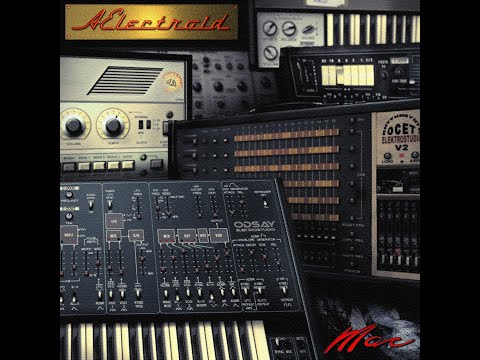
Kosmische Transmission — 2005 to 2010

2011 – 2015

2011–2015 was a strong period for Mac's Berlin School albums, with several standout works. Among the highlights: "Secluded," featuring one of his finest sequences, and "The River and the Railroad," a tribute to Tangerine Dream's '90s-era music, built around a wonderful cover by Uncle Sem — his first for the Classic EM series. Another worth mentioning is "Wasted," an album Mac recorded twice. As he put it in the inner cover notes at the time: "It had been quite a while since my previous Berlin School album, so I thought it was time I recorded another one. When it was almost finished, I listened to it and realized [...] it hadn't come from an inner need to make music [...] it had stemmed from a sterile decision. I don't care if my music is good or bad, but it must be honest, and that album wasn't. [...] I deleted those recordings, and started all over again, but this time listening to my soul."

"I don't care if my music is good or bad, but it must be honest."

Kosmische Transmission — 2011 to 2015

2016 – 2019

The 2016–2019 period was full of inspiration and a hunger to experiment. Among the more interesting albums from this stretch: "Temporal Distortion," recorded entirely with free VST instruments created by Kevin Brown; "Visible Galaxies" and "Delta Vision," made using only Tone2's synthesizer "Saurus," and counted among his most powerful works; and "Synchronical Events," recorded with a self-imposed limit of just eight tracks — a constraint that ended up fueling his creativity rather than restricting it.

"Self-imposed limits fuel creativity rather than restricting it."

Kosmische Transmission — 2016 to 2019

2020 – 2022

2020–2022 is probably one of Mac's best musical eras — there's essentially nothing from that period he'd eliminate. Standouts include "Lines of Ardesia," one of his finest and favorites; "Magnet," a wild experiment that sounds like a badly recorded, badly damaged tape; and "Orange Waves," with its deceptively quiet atmospheres running over a sequenced undercurrent. Then there's the trilogy he considers among his very best work and essential listening for any true fan of electronic music: "Magnitude," vol. 01/02/03. It might sound arrogant to say so, but there's a small handful of his albums he genuinely believes have objective value — and Magnitude is one of them.

"There's essentially nothing from that period he'd eliminate."

Kosmische Transmission — 2020 to 2022

2023 – 2025

The 2023–2025 era includes many albums worthy of multiple spins. Among his favorites: "Line to Infinity," a melodic, upbeat, but occasionally dark journey, and the start of a Berlin School sub-series called "Radiance Unit." He originally planned it as a trilogy and released three volumes accordingly, before later deciding to extend it into a longer ongoing string of albums. "Klarianst" is also considered one of his finest, while "Rust" was an odd, singular work made entirely with one obscure but fascinating VST synth called MP25 B.

"Many albums from this era are worthy of multiple spins."

Kosmische Transmission — 2023 to 2025

2026 – 2027

The 2026–2027 period is still developing... the journey continues.